
Resurrecting the Day the Music Died: How Churches Forgot the Congregation Was the Choir
A Lesson Under the Balcony
Once there was a church, Second Methodist, that prided itself that, though it was “Second,” it sat the largest chancel choir in the county. Every member wore not only a robe to match the church carpeting but a stole for every color of the Christian year. But time was not kind to the choir program. On this Sunday, Suzie reflected on the empty chairs in the choir loft, that now held guitars and drum sets for the contemporary service.
“I miss them so. I can still hear them!” Suzie remembered choir friends who crossed over Jordan. She glanced around this Sunday and saw some familiar choir faces.
“We have so many choir people in the congregation. Why is our singing such a dud?” She puzzled, missing the harmonic refrains that embraced her on the hardwood chancel cantata days.
But one Sunday, late for church, she entered through the back arched Sanctuary doors and took a seat under low ceiling balcony area. Speakers dotted along the ceiling, positioned to help those poor souls seated in sanctuary purgatory. Pot lighting too brightened the hymnals of those who drew the short-straw under balcony cheap seats.
But following that Sunday, a wonderful thing happened. Suzie opted again for the enclosed cheap seats under the balcony, along with her remaining choir friends. Even the remnants of the bell choir gathered, like chicks around a heat lamp on a -5 Missouri winter morning.
Soon the under-balcony seating area was first-come-first-served. Unlike the vaulted peak of the forward elegant seating, the cheap under-balcony seats held a magic that main area lacked. The old choir members voices found their parts again, not as an organized choir, but as though an angel had visited them in their grief over the missing choir ministry. Though the choir robes and stoles hung in their dark, closeted tombs, the harmonic embrace returned again, as though the old choir members became like children who discovered a hidden secret door on a playground.
What happened? How are the following alike: 1. The under-balcony seats, 2. The old Temple Beth Israel in Phoenix, 3. The adobe walled and hardwood floored sanctuary of Church at Litchfield Park?
I have sat in each of those seats and found the wonderful truth: People sing better when the room gives their voice back!
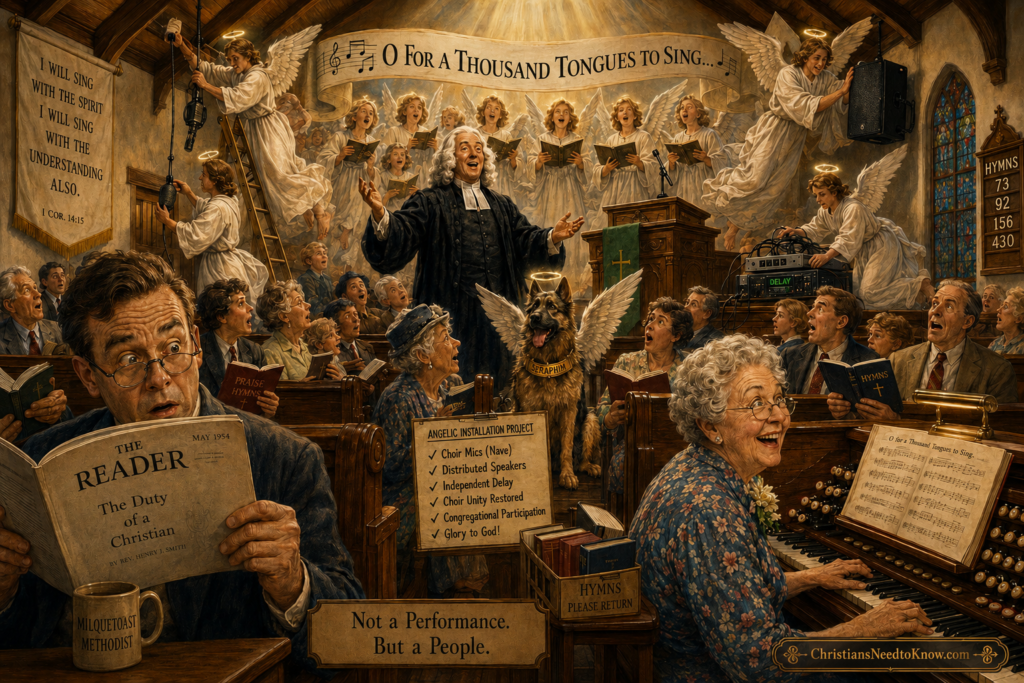
People sing better when the room gives their voice back.
JPB
The under-balcony seats, old Temple Beth Israel, and the Church at Litchfield Park remind us that, while some structures have perfect acoustics, like the Temple and the Church, a smaller church can discover a similar level of singing acoustics and return a vibrant sound to its congregational singing, without a huge financial cost.
As senior pastor of three churches and executive pastor of a fourth, my wife and I visited over 25 churches over the years and made some congregational singing observations. I am also indebted to Bruce Wardin of Wardin, Cockriel and Associates, a sound expert who inspired me with his acoustic insights as we rebuilt our church audio and video system as part of a six figure insurance claim. In particular, I had a front row seat listening to how he approached acoustical problems. By his side in Wardin’s acoustical visions stood Dr. Hal Walgren, whose generosity and shared vision made the acoustical work at the Church at Litchfield Park a reality.
While I can’t duplicate the Phoenix Symphony’s production of Handel’s Messiah on your hardwood chancel, I can share with you and your congregation some revolutionary acoustical insights for your sanctuary. These will range from the modest to the extravagant, depending on your budget. Whatever size your congregation, you will find resources for improvement. In fact, I wrote this with the less than 200 attendance church in mind. For those larger churches, let me know the results of implementing some of these ideas pastor.jim@christiansneedtoknow.com
The Church Parlor Effect
We have forgotten what Soren Kierkegaard argued: God is the audience. The congregation are the actors. Worship leaders are merely prompters or guides.
God is the audience.
The congregation are the actors.
Worship leaders are merely prompters or guides.-Soren Kierkegaard
Church sanctuaries are often treated liked parlors. A church donor or endowment fund make a gift of fine carpeting, heavy curtains and wall treatments, and rich bookcases. Sound in that room is swallowed up like singing with your face stuffed into a feather bed. Or, the acoustics could bounce off block walls and cement floors, turning the room into the acoustic blend of a preschool and disco.
Sadly, the same acoustical trap snares the unaware sanctuary. Fine carpeting is laid, along with pew cushions, for the comfort of the parishioners. The pastor is given the finest lapel mic, the piano is mic’d, the organ is cranked up. The church board backslaps one another on the fineries of the worship center.
Then someone says in a board meeting, “Young people don’t want to hear the organ! They want guitar and drums.” So the board approves a drum set, two electric and a bass guitar, with mics for the singers. A Bose sound system produces the finest sound possible from the front of the sanctuary. But the congregational singing still falls hushed like a cry into a memory foam pillow. The praise music simply transformed the hymns into a heavy metal straight jacket still restraining the melodic arms and legs of the congregation.
We built worship around the pastor’s voice, the choir’s polish, and the band’s mix, while the congregation became the foster child of the room. This was the congregation’s capitulation of the priesthood of the believer at the altar in deference to professional clergy and paid musicians. The task now is not to criticize the parlor church, but to adopt the congregation’s voice back into the architecture of worship.
We built worship around the pastor’s voice, the choir’s polish, and the band’s mix, while the congregation became the foster child of the room. This was the congregation’s capitulation of the priesthood of the believer at the altar in deference to professional clergy and paid musicians. The task now is not to criticize the parlor church, but to adopt the congregation’s voice back into the architecture of worship.
jim butler
The Old Methodist Secret
Someone said, “Methodists are Episcopalians who can sing!” That is true. The historic Methodist voices would rattle the hardwood floors and oak beams of their chapels, resonating the hillside like a fine cello. But a sad thing happened on the way to the electric church … the music died.
You may say, “Jim, how dare you! Why we broadcast on Youtube and get likes every Sunday! My mother even watches from her care home.”
Yes, but your congregational singing has succumbed to the parlor effect.
“You don’t know how gifted our church staff is! Why our associate pastor plays five instruments.”
Glorious. Ecstatic. I’m sure she’s having a wonderful time on Sundays, while your church members long to find their under-balcony experience. Afterall, the congregation are the players, right?
The Attack of the Bee Gees
In another attempt revive singing, Second Methodist nominated Sarah, a soprano, to lead the hymns (no one else volunteered). A strange thing happened, people actually started singing in the congregation. But something felt off.
Spectral Narrowing
The people who followed Sarah were the other sopranos. The male basses, baritones, and altos immediately dropped out due to senior ears unable to hear their parts. The tenors could not hear others to join. The result was a soprano led group solo, not unlike an odd remix of the Bee Gees singing the congregation version of “Stayin’ Alive.” This was the same in both traditional and contemporary services. Congregational singing sits an octave below soprano leadership. Psychologically, the lower parts, such as male voices, think, “I must be off pitch” and stop singing.
Harmonic Collapse
Let’s do a mental checklist. If your church has experienced the following, put a checkmark as part of your church singing differential diagnosis:
Once basses and baritones disappear:
* harmonic support collapses
* the room thins out
* altos lose anchor
* only brighter upper voices remain audible
That further encourages:
* more soprano dominance
* less male participation
It becomes a self-reinforcing loop.
In the Reformation vision, the people are not an audience gathered around religious professionals. They are a singing priesthood, a baptized choir, a whole-body instrument.
Acoustic Solution
The following will give both the church member, the leader, and the sound engineer a solution to work toward. This will take work.
The Under -Balcony Effect
The solution is stop making one high soprano carry the room and rebuild the hymn sound around the whole congregation.
Practical Patch {Highlight what would work for your church}
1. Lower the hymn keys
Drop most hymns 2–4 semitones. Put melodies where men, altos, and older voices can actually sing.
2. Use a lower lead voice
Best leader profile: alto, tenor, baritone, or mixed duet, not solo soprano dominance.
3. Lead from the nave, not only the chancel
Place one or two confident singers among the people. The congregation follows nearby voices better than distant stage voices.
4. Mic the congregation
Add 2–4 hanging choir mics over the nave, lightly compressed and EQ’d.
5. Use delayed side/rear speakers, with delay of 1 millisecond per foot
Feed the nave mics subtly into distributed delay speakers so people hear “the room singing,” not just the leader.
6. Turn the leader down
The leader should be a guide rail, not a soloist. Slightly above the congregation, not floating two octaves above the soprano section like a hymn drone.
7. Restore lower-mid warmth
EQ for human body:
250 Hz–1.5 kHz.
Do not scoop the mids. That is where men, altos, and congregational warmth live.
8. Use organ/piano as pitch anchor
Strong introductions. Clear melody. Supportive rhythm. Avoid wispy or dragging accompaniment.
Ideal Sunday setup
Leader: alto/baritone duet
Key: lowered for congregation
Sound: leader modest, congregation mics lightly reinforced
Speakers: delayed side fills, not front blast
Goal: everyone hears nearby human voices
The musical cure is simple:
Move from “follow the soprano” to “hear the congregation.”
That brings back the basses, the altos, the buried harmonies, and the courage to sing.
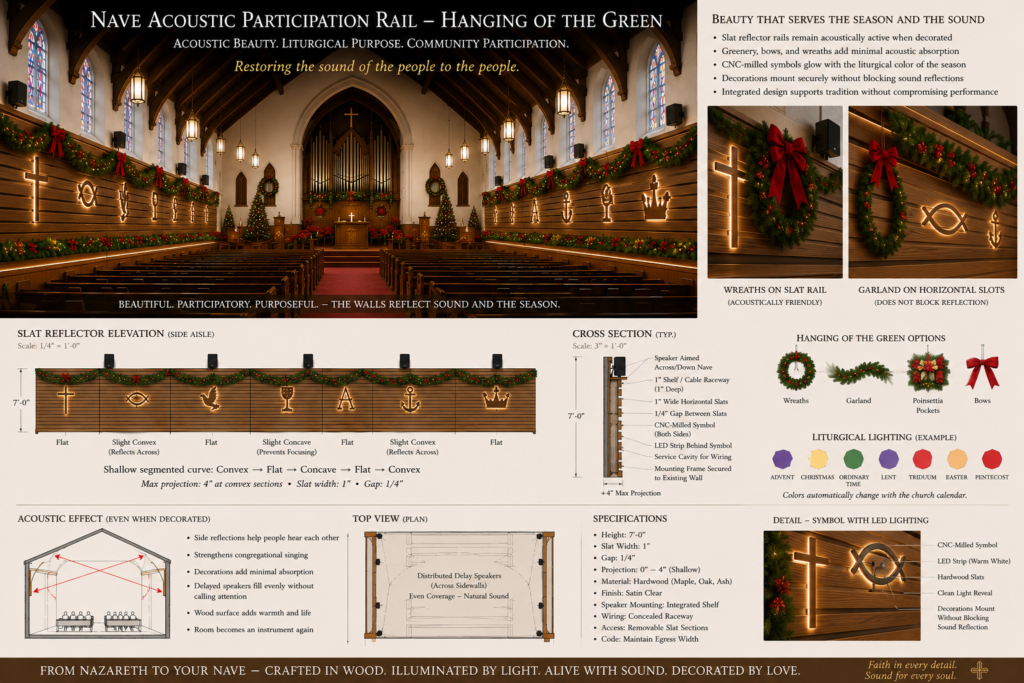
Congregation Acoustic Slat Reflection System
A Prototype
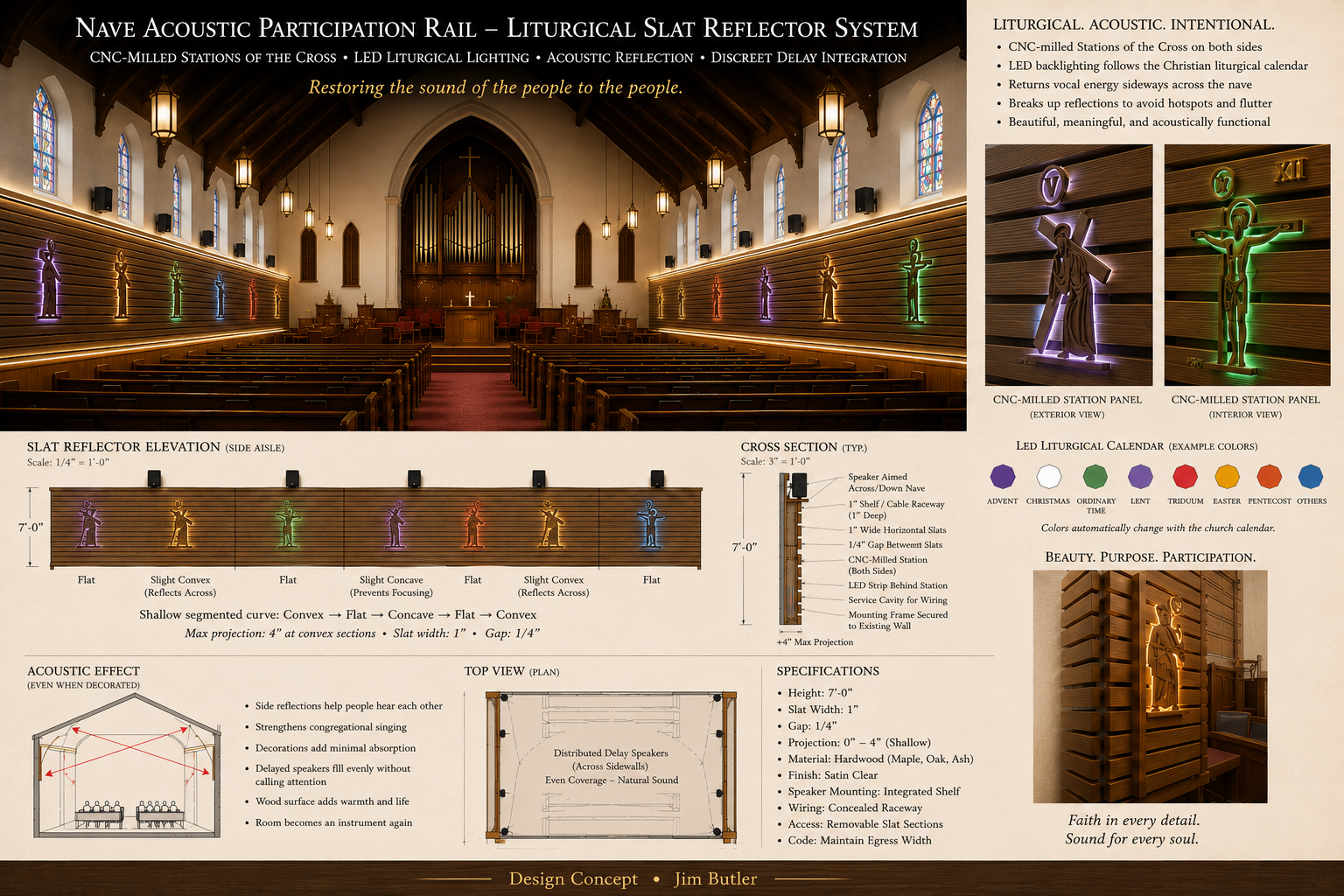
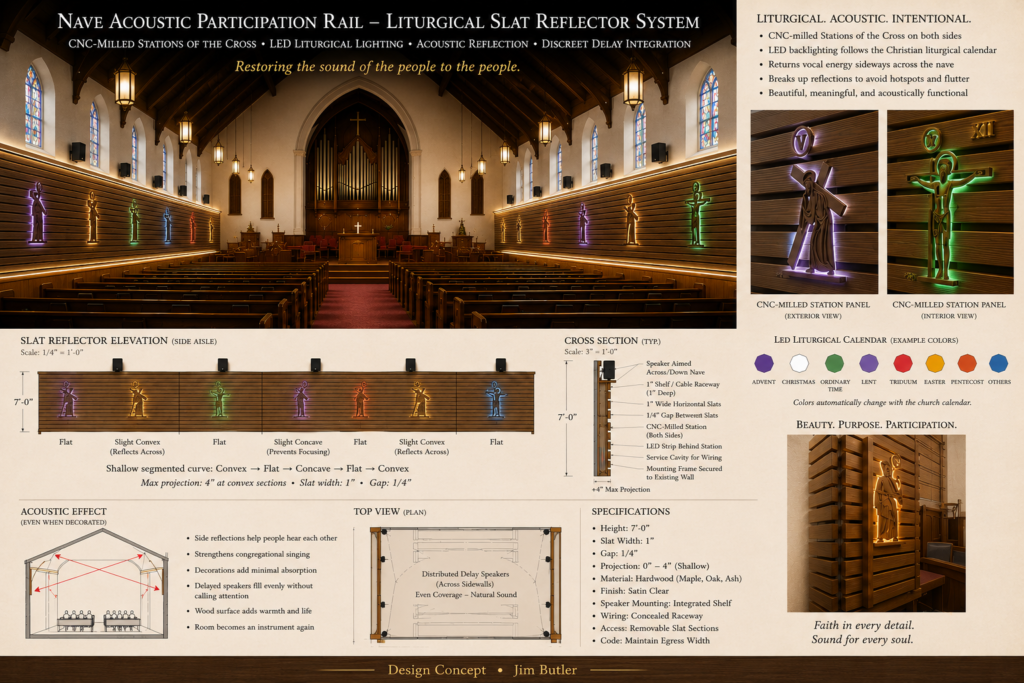
Suzie arrived at church after the congregation installed the Nave Acoustic Participation Rail. As she sat in her regular pew, she saw the four Audio Technica choir mics, that usually hung over her former choir, were added over the congregation. Along each side wall hung four Yamaha powered speakers delayed 1 millisecond per foot, again directed to the congregation. The subtle hardwood wave form of the sidewall panels gave the impression of gentle waves.
Once the congregation started, “O For a Thousand Tongue to Sing!” she felt again that which she had lost since the day the choir disbanded — the day the music died. She felt the harmony, the resonating baritones, altos, the climbing tenors, and soaring sopranos as they recaptured the beauty and power of the Methodist hymn sung by God’s people!
I created and submit this prototype to the church acoustic engineer crowd — a Nave Nave Acoustic Participation Rail – Slat Reflector System. The nave is where the congregation sits. Below are two designs. The key is that the wall system contains both concave and convex hardwood wave shapes to prevent echo effect.
A Living Wall
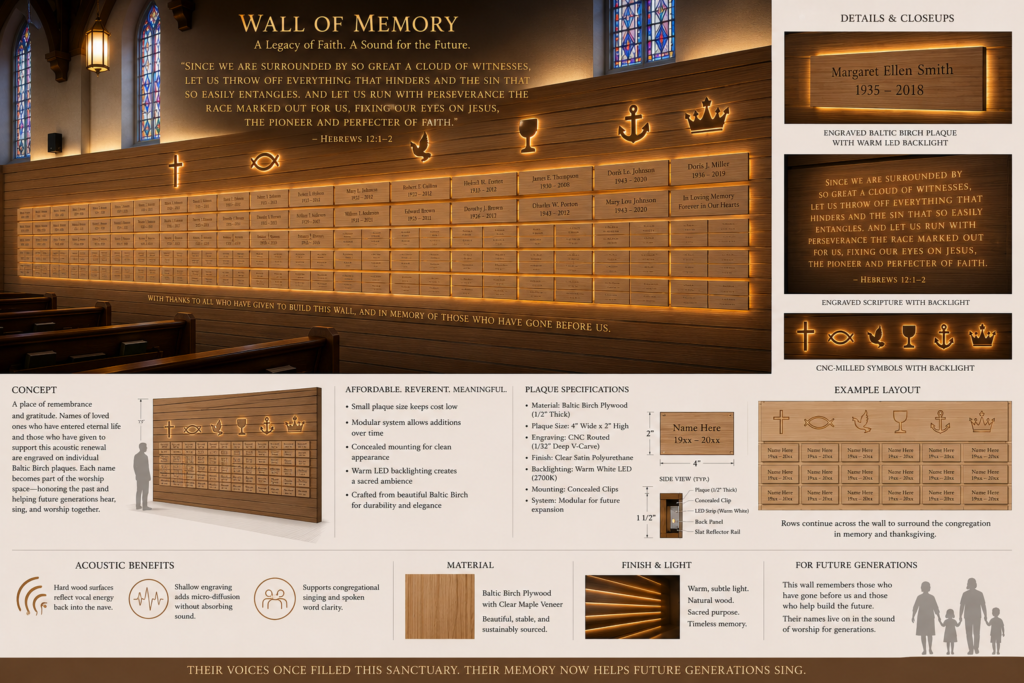
Memorial Baltic birch plaques
Once remembered in stone beyond the church doors, they are now remembered in wood within the living sound of worship. Wouldn’t this be an excellent way to remember our departed brothers and sisters, who accompany us as a cloud of witnesses?
Once remembered in stone beyond the church doors, they are now remembered in wood within the living sound of worship.
JPB
Worship the Lord with gladness;
    come before him with joyful songs.

                     -Psalm 100:2
In My Heart a Melody,
Jim
Acoustic Toolbox
Again the list below was put together with the smaller church in mind. The segmented wood reflector system could be built by a DIY group in a church. The size of the panel could be scaled to fit the congregation. For example, if everyone in your church sits two-thirds back in the sanctuary, create your own version of the acoustic slat system where the people sit. The goal is not “a noisy restaurant” rather the congregation’s “harmonic awakening” experiencing what those old Methodist church member’s felt when they roared, “O For a Thousand Tongues to Sing!”
Acoustical Wall Materials
Core Structure
Baltic Birch Plywood
Specification Recommendation
Type of wood for wall slat panels: Void-free Baltic birch plywood
Thickness 3/4” nominal
Grade B/BB or better
Purpose Structural slat substrate and reflector rigidity
Advantages:
* Excellent rigidity
* Stable under HVAC changes
* Excellent CNC machining behavior
* Acoustically lively
* Low resonance coloration
* Durable for long-term installation
⸻
Finish Veneer
White Oak Veneer (Preferred)
Specification Recommendation
Species Rift or quarter-sawn white oak
Veneer thickness Architectural grade
Finish Satin polyurethane
Appearance Warm neutral tone
Advantages:
* Warm reflective acoustic character
* Elegant sacred-space appearance
* Excellent dimensional stability
* Timeless architectural aesthetic
* Strong grain consistency
Note to Installers: These materials are not exotic materials, rather standard cabinet grade "Baltic birch plywood" cut with a table saw for the slats. The frame of the acoustical wall could be 1" x 4" birch, such as this shown at Ashby Lumber. Installation is as simple as nailing the slats to the wood frame using an 18 gauge brad nailer and wood glue.
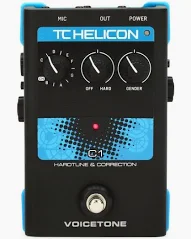
TC Helicon VoiceTone C1 Pedal {Real Time Pitch Auto Tune Correction}
Qty: 1 Approx Price: $150
Purpose:
- Very subtle pitch stabilization for hymn leader
- Helps congregation follow pitch center
- Should be used VERY gently
Musical Toolbox and Parts list
Revised Quality-Focused Budget
| Item | Qty | Approx Each | Subtotal |
|---|---|---|---|
| Yamaha DBR10 Powered Loudspeaker | |||
| Price: $449.99 | |||
| URL: https://www.sweetwater.com/store/detail/DBR10–yamaha-dbr10-700w-10-inch-powered-speaker?utm_source=chatgpt.com | |||
| Number of Reviews: 503 | |||
| Rating: 4.8 | |||
| Featured Tag: None | |||
| Merchants: Sweetwater + others | 4 | ~$450 | ~$1,800 |
| Audio-Technica PRO 45W Hanging Choir Microphone | |||
| Description: None | |||
| Price: $169.00 | |||
| URL: https://www.sweetwater.com/store/detail/PRO45W–audio-echnica-pro-45w-cardioid-condenser-hanging-microphone-white?utm_source=chatgpt.co | |||
| Number of Reviews: 81 | |||
| Rating: 4.7 | |||
| Featured Tag: None | |||
| Merchants: Sweetwater + others | Need 2 to 4 suspended over congregation | ~$170 | ~$340 |
| DBX DriveRack PA2 Loudspeaker Management System | |||
| Description: Speaker delay system | |||
| Price: $512.15 | |||
| URL: https://www.guitarcenter.com/dbx/DriveRack-PA2-1379945713612.gc?template=0y7n73MAL4Km&utm_source=chatgpt.com | |||
| Number of Reviews: 774 | |||
| Rating: 4.8 |
DBX DriveRack PA2 Loudspeaker Management System
$512.15•Sweetwater + others

Use this device to delay the congregation powered speakers 1 millisecond per foot.
Note: The assumption is that the church already has and uses a digital soundboard, such as a Behringer X32. Delay could be programed into sound boards like these, but I added the DBX DriveRack PA2 to manage the congregation speakers separately for clean separation. The congregation powered speakers must be used gently as they create awareness, “I can hear myself and others now when I sing” versus “I am now broadcasting.” The impression will be like one whose ears were stopped up felt such relief when they popped open.
So, there you have it. Let me know your experience as you rediscover congregational singing as an instrument itself. – pastor.jim@christiansneedtoknow.com